Tuesday, September 4, 2018

Napping and Walking during a British Holiday


I love a good nap.  I admired the audacity of this public napper, lying on a bench on the top deck of a boat on a journey down the Thames River. When I was in England, I managed to take a couple of my usual quick naps, but mostly there was too much to see and too many miles to walk.

My phone can track my walking miles, but not my napping minutes.  Google Maps is a nifty application which allows me to look at any day and see a map of my precise location, a summary of miles traveled, and times.  (To find it on your phone, go to Google Maps, to "Your Places", "Visited", and "View in Timeline".  It will also show photos you have taken in the various locations.)  

My phone says my sister and I arrived at Kew Gardens on August 14th at 12:31 p.m. and left at 5:19 p.m.  We began by walking .4 miles along the Broad Walk on our way to lunch at the Orangery.  The Broad Walk is a wide promenade bordered with 30,000 varieties of plants.  The Google app couldn’t capture the stop and starts that I made taking photos or my failure to remember the name of plant species in my rush.  Here was one of my favorite photos taken along the Walk.  I’ll just call the flowers “golden pinwheels”.  

       
Ordinarily, I take a short twenty minute nap after lunch, but instead my sister and I wandered through the Princess of Wales Conservatory.  The plants in the Conservatory were stunning and kept my attention.  Also, there were no benches for napping, but notice that while posing with hanging flowers, I do look fairly alert.  Again, I don't know the precise names of any of these plants.


Unfolding Leaves
A species of water lily with three to four foot wide pads.
  My sister gets this photo credit of the hanging orange flowers over my shoulder.
As we boarded a "land" train for a ride around the entire garden park, I noticed grandparents napping on the lawn with their two wide-awake grandchildren.  I was envious.  But Judith and I kept going.  We wandered through the recently-rennovated Temperate Glass House.

Only my fisheye lens could catch the immensity of this structure. Its opening date was 1863.


Near the end of our visit to Kew Gardens, coleus leaves seemed to cheerfully wave goodbye.  
Goodbye!
My sister and I (according to Google Maps) then rode a bus for 2.8 miles to our Airbnb flat and took the slightest of naps before walking again.  This time we walked to an Italian dinner in our neighborhood and then for a short walk in the neighborhood.


As we strolled along the Thames River across from Eel Pie Island, a man with a dog approached my sister and asked her if she had seen the "naked ladies".  Replying in the negative, he beckoned us down the walk and through an arch in the bushes.  And there were the Naked Ladies!  


The marble sculptures had been imported from France to be installed on the grounds of the York House, the home of a French family escaping the French Revolution.  The name of the artist has been lost.  

Something in the lily pond in front of the statues attracted the man's dog.  Our day ended with the sound of a British man calling his British Jack Russell.  "Dylan, come.  No, Dylan.  Come!  No!"  Google Maps indicated that we stood in the slowly failing light by the Naked Ladies and a determined dog until 8:42 p.m.  We then walked 350 yards to our cozy bed in our flat for a good night's sleep.  Dylan, the dog, put his paw in the lily pond, looked back at his owner and preceded us out of the opening in the hedge.         


Saturday, August 18, 2018

Close-up Views of the London Area

From Trix-colored bricks along a lane in Twickenham to polka-dotted leaves in a Kew Garden conservatory, little views like these are everywhere in the London area.  This selection of photos includes the moss-covered walls of a lock, a painted word on a Thames River bankside, and a modern-art-like wall in Hampton Court Palace.  As tiny as this collection is, it manages to convey the history of Britain and its capacity to attract people, words, and objects.  Notice the porcelain of a French pissoir in the gardens of York House, a pile of iron in a shipyard on Eel Pie Island, the odd word "loo", and a plate of the Italian dessert, Tiramisu, ordered in a restaurant on a cobblestone lane.

Take a moment with each little view.  Pretend you are traveling with me and can see what I saw.


Tuesday, August 14, 2018

London Through Fisheye Lenses


If I were a cod and bobbed up in the middle of the Thames in central London, I would be amazed.  Having recently bought a fisheye lenses, I have been envious of fish and their (supposed) perspective.  A three-hour trip from Westminster in London to Hampton Court Palace gave me the opportunity to practice seeing like a fish.

We began by slipping under the Westminster Bridge at low tide.

Before we left the dock, I stopped to examine a gorgeous monument to WWII with a familiar quote by Churchill. 
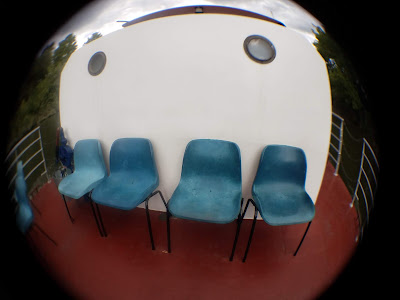
A sprinkling of rain made empty viewing chairs for awhile.

One of two locks.
As we progressed up the river, we saw more trees, houses and boating club

Perfect clouds.
Yew trees in Hampton Court Palace. 


And just for fun...a fisheye view of a tube station.

An edible fisheye!  A cronuts (cross between a croissant and donut).


Friday, July 20, 2018

Where I Sit to Write


Steven King wrote his first successful book at “a child’s desk in a trailer laundry-closet”.  However, once he became financially secure, he tried writing for six years at a large desk in the middle of a room with a good view, but he failed.  He then switched to a more modest-sized desk in a corner without a window and began getting published again.  In his book that is titled On Writing, A Memoir of the Craft, his first piece of advice for writers is this:  “… put your desk in the corner, and every time you sit down there to write, remind yourself why it isn’t in the middle of the room.  Life isn’t a support-system for art.  It’s the other way around.”  

Annie Dillard has similar advice in her book, The Writing Life.  She wrote that book in a primitive cabin on a remote island at a desk against a wall.  Dalton Trumbo, a writer from the last century, preferred writing in the bathtub. 

When I moved into my cabin, I ignored all their advice and examples.  Instead, I counted the places where I could sit with my computer or pen and paper and write.  I counted twenty-one places or twenty-two if I counted the bathroom facility. It has a nice view of an old lamp reflected in the glass subway tile of the tub.


Although there is merit in the advice of the above writers, I think the difference for me is the bounty of time and place.  Last year when I felt pressured to complete a manuscript, I set a strict writing schedule, turned off all media, and sat in one particular chair. 

But most of the time, I can let my mind or eyes wander.  Even Annie Dillard suggests taking a walk when the work seems stuck.  Living in the woods with views out every window and with the sound of the river a constant, I can take walks without moving from my seat.  The rock by the river in the photo above (seat number twenty-three) is the ultimate writing place from which to wander.


The ouzel birds wing past and the tall bankside grasses wave as a breeze wafts down the river.  Periodically, particularly with the air temperature in the nineties, I dip my feet in the cold water and watch the water striders for a moment as they stroke and backstroke in the eddies.  But mostly my attention is on the words on the screen.  Intent on the work, I am surprised when I look up an see the river coursing by – having forgotten its existence while I concentrated.

My writing rests on the skill of making connections between the ordinary and the unexpected.  This braiding of ideas is like the motion of my river.  As the water rushes over and around rocks, its currents are disrupted and then refolded into a new alignment of molecules pushed downstream or into backwater eddies.  Likewise, when ideas rush by and I can’t quite catch them, I look up and take a mental walk.  Meanwhile, my brain sets to work like it is the Corp of Engineers, damming the flow and channeling the thoughts, all without much assistance on my part.  When I return to my work, the ideas are waiting, stilled into a pool of thought.     


When the weather is warm enough in the spring, I often write mornings in a red wicker chair on the guest cabin porch.  As summer months arrive, the violet-green swallows, who nest in the cabin eaves, attempt their first flight.  If I am lucky, I am sitting in the chair on fledging day.  The young birds wobble past me over and over on unsteady wings.  By the second day, they circle the main cabin.

Can you spot the swallow?  The white spot against the house?

Here is a close-up view of the bird in the photo above.
By the third day, I can only spot the young swallows high against a deep blue sky.  I’ll admit I get less done than usual during the fledging week.  (And if the bear cub is in the cherry tree one cabin over, I get even less done.)  


On evenings, like tonight, I can be found in one of the green plastic lawn chairs left by the previous owners.  The final rays of light brighten the high hillside meadows across the canyon. The dog snuffles as she chews the bone she borrowed from the dog next door. Birds twitter, settling for the night.  After a while, I glance up again and the sun is now off the ridgeline and the sky is a soft gray.  I notice that the car in the evening light looks less like it needs a wash. Shortly, it will be dark though and it will seem like I am writing – as advised – in a corner without a view.  That is unless there is a moon rise.