Monday, October 7, 2019

Yellowstone National Park – Black, White, and in Color


Yellowstone National Park was gorgeous in sharp black and white prints taken back in the 1920s.  My Uncle Ted was on his honeymoon at Old Faithful Inn when he captured the highlights of the park.  Having loved those photos, I was almost surprised to drive into Yellowstone and have it in vivid color.  To ease the transition, I’m presenting my first photos in black and white.

The bison passed us in the on-coming traffic lane a short distance into the park from the northern entrance near Mammoth Lodge.  He gave me the once over as he passed.  Cars normal to him; bison not normal to me.

Yellowstone is home to wolves, foxes, bears, antelope, elk, deer, and bison.  We saw herds of the antelopes in meadows and a gathering of elk on the front lawn of Mammoth Lodge. There is a certain shock and pleasure to see so many large mammals in the wild.  I have already promised myself to return one year in the winter for more likely sightings of wolves and foxes.


For our first stop we circled formations made by the deposits of geysers.  

At the foot of one of the humps, the colors were black and white and appropriately, also, a tinge of yellow.  Yellow stone!


The colors of the various hot pools and the stained mud or rock formations depend to some extent on the microbes and bacteria found living in the range of extreme temperatures.  The colors are disconcerting and memorable.  Early photographers could not capture their essence, but I could.


Yellowstone Park encompasses what is described as a cauldron.  Where there were once mountains – long since blown to smithereens in an enormous explosion – there is now a basin simmering with geysers, and hot pools, and waterspouts.  I was surprised to see something every few miles. 


And, of course, we saw Old Faithful.


And tourists.


We arrived just before most of the Park facilities will be closed for the winter.  We saw the last of the buses filled with tourists from Japan, China, and Europe stopping at every major site.  The delight of the guests evident in their joyful chatter.  Many of the shops were empty of summer college staff and were therefore manned by some Chinese on temporary work visas!  They lent a worldly aura to this treasure of a place. 

On equal footing with the spectacular natural world was the Park’s literature and signage emphasizing its concern about and their effort to avert the effects of climate change.  An entire page in an introductory booklet described what they have begun seeing as consequences to shifting seasons and temperatures and what they have been able to change in their practices as a result.  I failed to photograph the recycling bins placed everywhere or the requests to alert the maids when they could avoid doing laundry, but each impressed me as much as Old Faithful. 

I’ll end this post with a photo of the old cabins at Yellowstone Lake Lodge.  They haven’t been torn down, but they have been updated to be more energy efficient – a worthy step towards the preservation of this wonderous cauldron of surprises.  


Monday, September 2, 2019

Lunch at Les Schwab's


Lizzie and I ate out at Les Schwab’s in Enterprise.  A bacon blue cheeseburger with chips for me and Science Diet Dental dog food for her.  Afterward, Lizzie circled once and lay on the cool linoleum floor. 

As a restaurant, Les Schwab’s decor resembles that of a White Castle burger joint – white and spotless clean.  The smell was of freshly made tires.  The service was gracious, quick, and friendly. I don’t often eat at Les Schwab’s (unless it’s their heavily salted and buttered popcorn), but when I had a flat up Lostine Canyon in the Eagle Cap Wilderness area in Oregon, I didn’t have a choice.

I have camped in Lostine for almost twenty-five years and this was only the second time that there was a snafu.  I was due for another.  
The very first time that I camped in the canyon, I forgot the cooler.  My daughter and I had to make do with peanut butter and honey sandwiches.  The error was rectified when a neighbor offered unlimited quantities of smores to supplement our slim diet.  It was a wonderful and memorable trip.  

On this year’s trip, the flat tire was complicated by having recently gotten new wheels and the Subaru lug wrench did not fit the new lug bolts.  I could not even put the spare on.  Lizzie and I wandered the dirt road outside the campground while waiting for the Les Schwab tire repair guy to rescue us.  I took a few photos of Russian thistle with my clip-on phone lens.


  I had intended to spend the morning hiking with friends who were going to be camping in the mountains.  I was sorry to miss the opportunity.  But just like the first year, there was a compensation.  First, I got to eat a relaxed lunch of that left-over burger purchased the evening before from Terminal Gravity in Enterprise.  Second, I had plenty of time to pick huckleberries on the way home off Balloon Tree Road in the Blue Mountains. 


               The Science Daily had a recent article about how people who are optimistic live longer.  “Optimism refers to a general expectation that good things will happen or believing that the future will be favorable because we can control important outcomes.”  I have gotten increasing good at looking at the bright side of unfortunate happenings.  Having a flat way up a rough canyon road, gave me one more opportunity to be optimistic, cheerful in the face of adversity. 

               And maybe even contribute to my living a little longer!       

Friday, August 2, 2019

Summer Photos in the Blues and Their Close Proximity

  My latest summer electricity bill only $16 or so.  The canyon is so much cooler than town, that I even wear long sleeves inside most of the day without having to use the air conditioner.  The early cool mornings and the breeze in the canyon encourages me to get out.  A new hiking partner and his dog, Stella, get Lizzie, my dog, to get off the couch and wander off leash.  It has been a good summer for all of us to add muscle and breath fresh air.

  My computer goes to the shop today, so I thought that I would at least post a few of my favorite summer photos.  Enjoy!

Wheat ready to harvest on the ridge into the canyon.
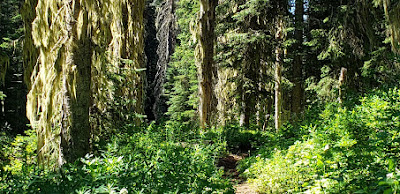
South Fork of the Walla Walla River Trail from the top.  The quanity of hanging moss is impressive.

Stella fetching sticks in the pond near Deduct Springs

Lizzie cooling her belly in a stream.

A split-trunk Ponderosa pine in the late afternoon sun.

The south end of Indian Ridge Trail.

The essense of a cabin for a mouse!  Found on a trail.  

Red-tailed honeybee on a green cone flower.

And the neighborhood cherry picker! A cinnamon bear with a little notch out of his ear.
  Hope your summer has been equally delightful and includes bears, bees, and sky.


Sunday, June 23, 2019

Adding to a Life List of Wildflowers in the Blue Mountains


Searching for wildflowers is like looking for interesting new acquaintances.  You leave your house and head towards likely locations.  Because you have expectations and done some research, you arrive and begin surveying the landscape.  If you are fortunate, you are accompanied by trustworthy friends or guides.  When you see a new flower or meet a new person, you work at remembering their name.


The Blue Mountain Chapter of Audubon schedules an annual wildflower field trip to the Blue Mountains with Jeff and Cheryl Fredson as guides.  Cheryl has written a wildflower guide for the area (unfortunately out of print) and Jeff is an equally well-versed partner.  This year, Mike Denny joined us bringing his extensive knowledge of plants, bugs, and the Umatilla Forest.  As with most years, the company included old and new friends.

The Brown's peony or western peony (paeonia brownii) was this year's stunning "life of the party".  On Summit Road past Tollgate off Highway 204, this peony blossomed in a small cluster just south of the pond at the trailhead for Nine Miles.  The peony is named after the Scottish botanist and explorer, Robert Brown.  It is one of only two native species in the United States.  I have added it to my life list of wildflowers.  I doubt that I will forget its name or appearance.       


The flower's blossom hangs downward showing only it's brownish backside.  Taking photos demands creative angles or the hand of a friend to hold the flower's face skyward.


The pond by the peonies reflected thunderheads and blue skies.  The day was lovely for scouting.


A campground stretches into the woods beyond the pond.  Walking even a short distance into the dark evergreen forest, a dozen or so different flowers bloomed in the shade.  Although I have seen this white flower before,  I am determined to remember its name this year.  It is a woodland star (Lithophragma pariflorum).  They are small, but striking.  They are one of our native species.  


Nearby at the edge of the forest was a common camas flower (cammassia quamash).  These distinctive purple and yellow flowers were in abundance at almost every stop on the trip.  The camas plant was a coveted as a food source by the North American indigeneous populations.  It is not a new flower to me, but one that I always hope to see. (I wish I had a house with a front door in one of the shades of camas purple.  Pizza delivery folks could always find me then!)  


Two years ago, I learned the name of old man whiskers (geum triflora), but this year I added a new species called sugarbowl (Clematis hirsutissima); it has a similar wild-hair appearance.  Three sugarbowl specimans found on a roadside bank are pictured below in the seed stage.  In the next photo down are a few old man whiskers blossoming in their flower stage.


The third old man whiskers flower from the left below is just beginning its transition to the whisker-like appearance similar to that of a sugarbowl.  


We found one flower in a new color.  Giant-head clover (trifolium macrocephalum) are ordinarily tinged with deep shades of pink, but here Mike Denny noticed a white variation.  The ant gives some perspective on the clover's size.


Two pink giant-head clovers located near the white one are starting to dry to an orange.


Dry, but still striking.


We stopped for lunch on an overlook near a trailhead to a forest lookout tower.  While we sat watching for bluebirds and butterflies, we examined dryland flowers around us.


Our two last stops were at Bald Mountain and Target Meadow Campground on the turnout towards Jubilee Lake.  The boggy meadow at the campground was the site where we found slender bog orchids (platanthera stricta).  This one had been broken at the stem and hung in a curl.  So many of the plants in the area were predominately green; this one might have been overlooked.     


I'll end this post with a flower found on Bald Mountain.  This is a creamy buckwheat (Eriogonum heracleoides) in both the budding and pod stages.  It made a striking picture.    


As always, my list contains species whose names I did not catch.  The green flower below, I'll leave for another year.  I was too distracted by the bee to inquire as to its name.  Next year...


Thursday, May 23, 2019

Naming My Dandelions


                                                               Lady Queen Ellie

 "Christopher throws dandelion head after dandelion head into his bag.  It's getting heavy now and his fingers are stained from the work but there are still so many left to kill.  His biggest mistake was giving them names."  Quote from Brian Martinez's novel Kissing You Is Like Trying to Punch a Ghost

  I tossed my own share of dandelions into a bag this spring.  The usual crowd of common weeds reappeared on the slope leading up to where I garden in a couple of barrels that sit on the hillside in back of my cabin.  The soil on the rise is so hard and rocky that I never dig up all the dandelions' root systems.  Invigorated from their winter rest, the plants re-emerge from their old root stock, healthy and tall. 

  I don't name individual heads.  Or I haven't until now. 

  Lady Queen Ellie, pictured above, was down the road sunning in the late afternoon last week. Below the ruff at her neck, her body was cinched long and tight above the flounces of her leafy skirt.  She held her head as if careful of her coiffure, enjoying the interlude before her company arrived. The breeze coming through the pines was expected by nightfall.


  I haven't much noticed individual dandelion heads.  As author Doug Larson so aptly puts it: "A weed is a plant that has mastered every survival skill except for learning how to grow in rows."  Dandelions arrive as a swath of yellow, a crowd heralding spring, bees, and weeding.

  But this year after most of my weeding was done, I noticed something that I hadn't particularly seen before.  After a light rain, a few of the dandelion heads down the road were just opening their feathery flight mechanisms.  The thin white shapes and fans were dotted with tiny drops of rain.  At first I thought that the specimans were a rare form of dandelions with their narrow white segments, but now I know that I had caught them in their transition stage from a bunched white bouquet to a spray of airy fans.


                                                             This is Miss Lilly White.
   

      And this is Captain Reginald Poof, floating in a puddle, beckoning a brown bug to come aboard.

         I am worried about next year.  What if every dandelion I kill, I feel compelled to name?


                                                                    Starship Hurtle


                                                                The Gang of Go Lightly
 
  Or, worse yet, what if I must name every seed:  Lazy, Twinkle, Twinleys, Pop, and Helicopter.  I would then have to name the obsession.  How about dandeonomamania (mania for naming dandelions)?  Ono.  That's a nice name, isn't it?